In MINDFULGym program, mindfulness training is defined as remembering to pay attention to the present moment with kindness,
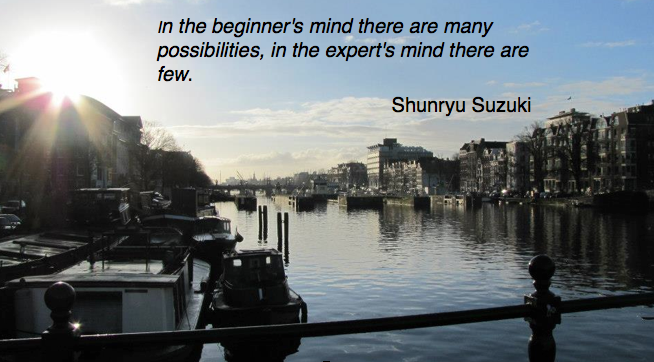
beginner's mind and wisdom. The concept of "beginner's mind" is emphasized in Zen Buddhism. It refers to having an attitude of openness, eagerness, lack of preconceived or fixated ideas, when studying a subject or experiencing life. Other words for it include "zen mind," "open mind," "don't-know mind," and "non-judgmental mind."
Benefits of beginner's mind:
1. Learn more effectively.
2. Appreciate the richness of life.
3. Solve problems creatively.
4. Release unhelpful habits.
5. Better communication & relationships.
Zen story: Emptying Your Cup -
HERE.
Below are 7 ways for cultivating beginner's mind:
1. Do something routine in different ways.
Life becomes more interesting with simple adjustments:
- Use a different route to work.
- Park your car in a different place.
- Sit in a different position during meeting.
- Use the stairs instead of lift.
- Chant in a different sequence.
- Walk in a different posture.
- Use a different toilet bowl.
- Teach using different styles.
- Eat in different restaurants.
- Sleep on a different side of the bed.
2. Observe something without using labels, names or words.
When you're experiencing something (e.g. wind), try doing that without calling it "wind." As we label in our hearts, "it's wind," we're limiting our experience to the preconceived idea of what "wind" is. We become a know-it-all and it's a hindrance to discovering new experience related to "w...." Try to sense and feel the...
Song of the Wind (Plum Village song)
I listen to the song of the wind that has no name
I listen to the song of the wind that has no words
I listen to the song of the wind that I can see
The wind is real, the wind is real
I listen to the song of the sky that has no name
I listen to the song of the sky that has no words
I listen to the song of the sky that I can see
The sky is real, the sky is real
I listen to the song of the moon that has no name
I listen to the song of the moon that has no words
I listen to the song of the moon that I can see
The moon is real, the moon is real
You Tube -
HERE.
3. Imagine bringing along a child and experience life with child-like curiosity.
"The real voyage of discovery consists not in seeking new landscapes, but in having new eyes."
- Marcel Proust.
4. Answer questions with "yes," and "no," depending on situations.
Try to be open minded in our views by having "yes" and "no" answers to any questions. For example, "Should a student work hard in studies?" The answers could be "yes," if the student lacks discipline in his or her studies. And the answer could be "no," if the student is too serious in studies to the extend of feeling depressed and suicidal. In life, often there's no absolute yes/no, right/wrong or good/bad; it
depends on situations.
"A mind is like a parachute. It doesn't work if it is not open.” - Frank Zappa.
What do you think? Yes, you're right and i'm correct...
When "yes" is correct, "no" can also be correct.
Zen story: You're correct too -
HERE.
5. Slow down, relax, and be mindful of the present moment experience.
When stressed out, we often function in an autopilot mode, and we
react to challenges with unhelpful habits (e.g anger outburst, binge eating, feeling guilty). On the other hand, when we're calm and mindful, we're able to
respond to challenges with wise decisions and helpful solutions.
How can we easily slow and calm down, and rest in the present moment?
Take a Mindful-
S.T.O.P. and contemplate on the poem, "
Slow Dance."
 6. Don't belief our thoughts too seriously.
What we believe are often conditioned by our mood and 'shadow' of past experience. For example, a phone call from a friend requesting for help may be interpreted differently depending on situations. When our mood and past experience are positive, we'll likely interpret it as, "It's so nice that my friend trusts me and shares his/her problems." Otherwise, it could be interpreted as, "Oh no, he/she's trying to use me again!" If we're not sure whether to believe in something, it's better to get a second opinion from a friend.
7. Try new experience and challenges.
Don't be afraid to try new things. No matter what happens, it's always a learning experience. When we experience life from different perspectives, we have a more complete picture of life.
Story:
Elephant & The 6 Blind Men.
Photo credits (baby and thought bubble): Pixabay